The last two weekends I have hosted baby showers for two very important people in my life. We had a blast of course and the parties were filled with Ooohs and Aaaahs!
Wednesday, February 23, 2011
Baby Showers Galore and Cinnamon Bun Popcorn
The last two weekends I have hosted baby showers for two very important people in my life. We had a blast of course and the parties were filled with Ooohs and Aaaahs!
Tuesday, February 22, 2011
Spinach, roasted red peppers, and broccoli Pizza
I had some leftover homemade wheat pizza dough and decided to put it to use. I found this recipe from one of my favorite blogs, Pink Parsley, and modified it a little bit (She actually adapted it from another favorite of mine, Annie's Eats!). Turned out very yummy! It also helps that Ryan Grilled it on our Kamado Joe. Yes, you heard that right, the weather is nice so we can finally grill again! I long for the warmer weather where most of my food is cooked on the grill... i.e. less dishes to clean!
- 1 serving homemade pizza dough (this recipe makes 2 so just used 1/2 of it)
- 1 Tbs butter
- 1 Tbs flour
- 3/4 cup milk (I used 1%)
- 3 garlic cloves, smashed
- salt/pepper to taste
- 1 tsp crushed red pepper flakes
- 6 Tbs freshly grated parmesan cheese
- 1 cup broccoli florets, chopped into bite sized pieces
- 1 cup chopped fresh spinach, packed
- 1 cup roasted red bell peppers (I used the jarred ones)
- 1/3 cup shredded mozzarella cheese
- 1/3 cup shredded extra sharp cheddar cheese
Tuesday, February 15, 2011
Valentine's Day
Sunday, February 13, 2011
EDAMAME
This is a nice snack that I have been enjoying lately. Good source of protein and other nutrients. Quick and easy to make and so much fun to eat!
Friday, February 4, 2011
Cajun (Chicken) Pasta
This dish was amazing. When we were celebrating at the Renner wedding, Destin mentioned this recipe and sent the recipe to me. I made it that week and we both loved it. It was pretty easy to assemble and prepare and made excellent leftovers. I especially loved the baby bella mushrooms! And the spice is right on.
Monday, January 31, 2011
The Government says to "EAT LESS" - WOW
Government’s Dietary Advice: Eat Less
The latest nutrition guidelines reiterate much advice from previous years: eat less salt and saturated fats, eat more fruits and vegetables and whole grains.
By ANDREW MARTIN
Published: January 31, 2011
As the nation’s obesity crisis continues unabated, federal regulators on Monday issued their bluntest nutrition advice to date: drink water instead of sugary drinks like soda, fill your plate with fruits and vegetables and cut down on processed foods filled with sodium, fat or sugar.
Add to Portfolio
The New York Times
Readers' Comments
Share your thoughts.
More important, perhaps, the government told Americans, “Enjoy your food, but eat less.” Many Americans eat too many calories every day, expanding their waistlines and imperiling their health.
While the recommendations may seem obvious, it is nonetheless considered major progress for federal regulators, who have long skirted the issue, wary of the powerful food lobby. (The 112-page report even subtly suggests that people eat less pizza and dessert.)
Previous guidelines urged Americans to curb sugar, solid fats and salt, but avoided naming specific foods, let alone urging consumers to eat less food over all.
“For them to have said ‘eat less’ is really new. Who would have thought?” said Margo G. Wootan, director of nutrition policy at the Center for Science in the Public Interest. “We should have been saying ‘eat less’ for a decade.”
Ms. Wootan said she was nonetheless pleased that the guidelines provided “understandable and actionable” advice rather than the “big vague messages” of the past.
For instance, she applauded the advice to make half of your plate fruits and vegetables.
“Before, the dietary guidelines said, ‘Eat more fruits and vegetables,’ but that could mean add a slice of tomato to your hamburger,” she said.
Robert C. Post, deputy director of the Center for Nutrition Policy and Promotion at the Agriculture Department, said regulators hoped simple messages would resonate better than the more technical prose of the past.
“Maybe that is what will help this time to get the consumer’s attention,” he said.
While the guidelines are ostensibly for consumers and federal nutrition programs, they will undoubtedly put additional pressure on the food industry to reformulate processed foods, particularly to reduce the amount of sodium, which was emphasized in the report.
Similarly, the guidelines’ advice to reduce portion size could put pressure on restaurants, many of which continue to serve portions so large that they could easily serve two people under the government’s guidelines.
“If companies don’t change their practices and reformulate their products, people don’t have a chance of following the dietary guidelines,” Ms. Wootan said.
Just two weeks ago, Wal-Mart Stores announced a five-year plan to reformulate its store-brand packaged foods and drop the price on fruits and vegetables. Wal-Mart said it would pressure its major suppliers to do the same.
In addition, the first lady, Michelle Obama, and Mayor Michael R. Bloomberg of New York have pushed for manufacturers and restaurants to reduce the amount of trans fatand sodium in their products.
Several food manufacturers noted that they had already taken major steps to reduce the amount of sodium in their products, though some critics say they have not gone far enough.
“We feel great about the progress we are making,” said Susan Davison, a spokeswoman forKraft Foods, one of the largest food makers in the world. The company has vowed to reduce sodium in its North American portfolio by an average of 10 percent by 2012, and Ms. Davison said it had already met that goal in 350 products and would eventually reformulate more than 1,000 products.
“We know that our consumers are interested in monitoring their sodium intake,” she said. “We are looking for ways to help them without giving up the foods they love.”
David S. Smith, a vice president at Campbell Soup who oversees research and development, said his company was offering reduced-sodium versions of hundreds of its products, in some cases replacing regular salt with smaller amounts of sea salt. He said the company was continuing to look for ways to cut sodium even further.
Salt is not an easy thing to replace, he said. “It is very challenging.”
The specific recommendations on various nutrients were largely unchanged in this year’s guidelines, compared to the last version in 2005, though reductions in sodium were given much greater emphasis.
Under the guidelines released Monday, about half of the populace should consume 1,500 milligrams of sodium or less each day. That includes children, African-Americans and anyone who is older than 50 or has hypertension, diabetes or chronic kidney disease. Everyone else may consume up to 2,300 milligrams, about a teaspoon.
Now, Americans on average consume about 3,400 milligrams of sodium a day.
In addition, the guidelines recommend consuming less than 10 percent of calories from saturated fatty acids, replacing them with so-called good fats like monounsaturated and polyunsaturated fatty acids.
The guidelines suggest making fruits and vegetables cover half of the plate at a meal, choosing fat-free and low-fat dairy products and eating more whole grains and seafood.
August Schumacher Jr., a former agriculture under secretary, said government farm policies needed to be revised to provide incentives for farmers across the country to plant more fruits and vegetables.
In addition, Mr. Schumacher, now executive vice president of Wholesome Wave, a nonprofit group that promotes access to healthy foods, said the government needed to help consumers, particularly those on food stamps, get access to fruits, vegetables and other foods recommended in the guidelines.
The Department of Agriculture and the Department of Health and Human Services revise the Dietary Guidelines for Americans, a thick booklet that lays out an ideal diet to maintain health, every five years. The panel produces a draft that is reviewed and tweaked by regulators and eventually made public.
In 2005, the last time the guidelines were revised, the government urged Americans to eat more whole grains and less sugar. It was the first time the guidelines recommended replacing refined grains with whole grains, and it prompted major changes in the ingredients used by food manufacturers.
General Mills, for instance, replaced refined grains with whole grains in its breakfast cereals, and many bread makers did the same.
While the guidelines urge Americans to eat less, they do not change the suggested daily caloric levels for most Americans, which vary depending on age and activity level.
But many Americans already eat more calories each day than they are supposed to eat by ignoring the dietary guidance.
Karen Miller-Kovach, chief scientific officer at Weight Watchers, said she was particularly pleased that the advice was so simple. The two overarching themes of the report are: maintain calorie balance over time to achieve and sustain a healthy weight, and focus on consuming nutrient-dense foods and beverages.
“The last many guidelines have focused on process, this many milligrams of sodium, that much fat. I think what these do is lay out the basics,” Ms. Miller-Kovach said. “If you cut calories and you make those calories count in terms of those nutrients, what happens? All those numbers fall into place.”
Sheryl Gay Stolberg contributed reporting.
Thursday, January 20, 2011
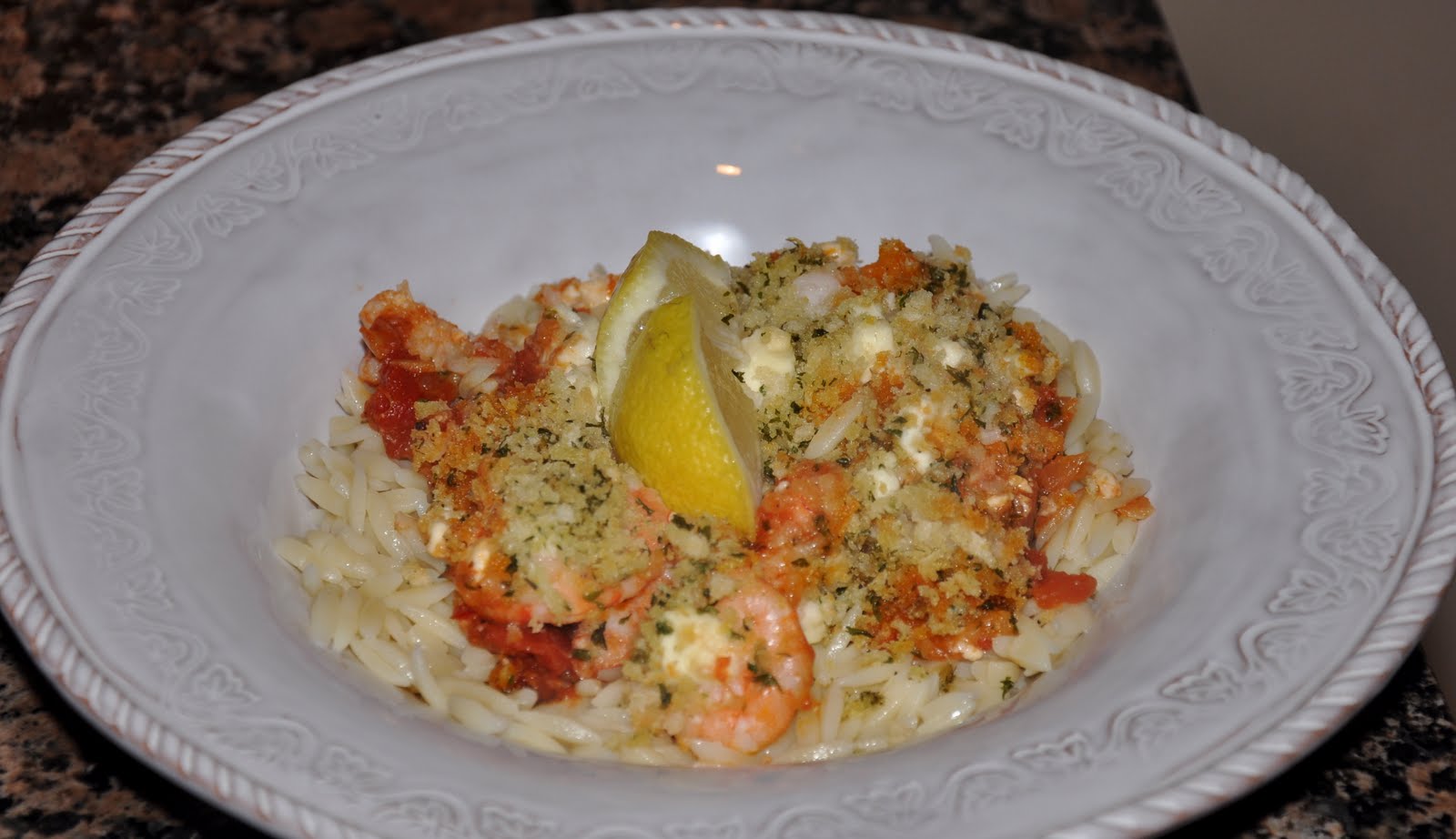
Shrimp with Feta and Tomatoes
Made this last night and it was delicious. Probably one of the tastiest and easiest dishes I have made lately. Served it on top of hot Orzo pasta which is likely my new favorite pasta! Of course it was from INA GARTEN! I am obsessed with the new cookbook my mom got me for Christmas. If you are in the hunt for an awesome cookbook, this is your best choice! Make sure to serve this on Orzo pasta, it really completes the meal.
serves 4
- 4 Tbs olive oil, divided
- 1 medium onion, diced
- 2-3 coves garlic, minced
- 1/3 cup dry white wine
- 1 (15-ounce) can diced tomatoes
- 2 tsp. tomato paste
- 1 Tbs minced fresh oregano
- 1 tsp. kosher salt
- 1/2 tsp freshly ground black pepper
- 1 1/4 pounds (16-20 per pound) peeled and deveined shrimp
- 3 ounces feta cheese, coarsely crumbled. Original recipe called for 5 oz, but that seemed like way too much for us, so I used 3
- 1 cup panko bread crumbs
- 3 Tbs minced fresh parsley
- 1 tsp grated lemon zest
- 2 lemons
Heat 2 tablespoons of the olive oil in a 10 to 12-inch oven-proof skillet over medium-low heat. Add the onion and saute 5-8 minutes, until tender. Add the garlic and cook for 1 minute. Add the wine and bring to a boil, scraping up the browned bits. Cook 2-3 minutes, until the liquid has reduced by half.
Add the tomatoes with their liquid, tomato paste, oregano, salt, and pepper to the skillet. Stir to combine and simmer over medium low heat, stirring occasionally, 10-15 minutes.
Meanwhile, combine the breadcrumbs, parsley, lemon zest, and 2 tablespoons of olive oil in a small bowl. Stir well to moisten the breadcrumbs.
Remove the pan from heat and arrange the shrimp, tails up, in one layer over the tomato mixture. Scatter the feta evenly over the shimp, and sprinkle the breadcrumb mixture on top.
Bake for 15 minutes, until the shrimp are cooked and the bread crumbs are golden brown. You may want to turn on the broiler for the last few minutes. Squeeze the juice of 1 lemon over the shrimp, and serve hot with the remaining lemon cut into wedges.